
Construction operations
From site paperwork to one construction operations system.
For a construction-industry client, Cerato Systems designed Navixor: one system replacing paper site logs, machinery, fuel and work-hour records, and approvals that previously waited for people to meet in person.
The platform gives field teams a practical way to record work, while supervisors and management see the operational state of every site from one connected system.
- Industry
- Construction
- Operation
- Multi-site
- Users
- Field teams to management
- System
- Custom web platform
The challenge
The company had software, but the operation still ran on paper, spreadsheets, and calls.
People were not avoiding record-keeping. The problem was the rhythm of construction work: teams are on site, the information they need changes through the day, and the office is often elsewhere.
Site data was not entered regularly, so the backlog built up until periodic reporting — especially annual fuel and material reporting. Site logs, trip orders, work hours, and machinery servicing information were spread across notebooks, spreadsheets, phone calls, and individual knowledge.
Approvals became a bottleneck when a supervisor needed to sign a site log that was physically on site. Management had no real-time view of workers, sites, or idle machinery without calling around.
The problem was not a missing screen. It was an operational chain that broke between the site and the office.
The goal
Make operational records easy to capture in the field and useful for decisions in the office.
The goal was to create one practical system for the people doing the work, the supervisors reviewing it, and the managers responsible for the wider operation.
That meant building around four clear entities — sites, machinery, workers, and companies — rather than creating another overloaded menu of unrelated tools.
The first priority was the operational backbone: a digital site log and supervisor approval workflow. Everything else could then connect to the same source of truth.
Field teams record what happened. Supervisors review it. Management sees what needs a decision.
The solution
A role-based construction operations platform built around the real workday.
Navixor gives each role a focused view of the operation. Field teams can enter the required information from a phone in a few steps, when they have time. Supervisors can review and sign from wherever they are. Management sees the state of the company and the work that needs attention.
Instead of making people reconstruct the operation from calls, paper, and separate files, the system connects site logs, workers, machinery, fuel, work hours, approvals, and reporting through shared operational data.
- Digital site logs
- Supervisor review and approval
- Worker and work-hour records
- Machinery status and service planning
- Fuel records and reporting
- Role and location-based access
- Operational dashboards
- Exports and reporting
Operational control
The dashboard turns follow-up work into clear decisions.
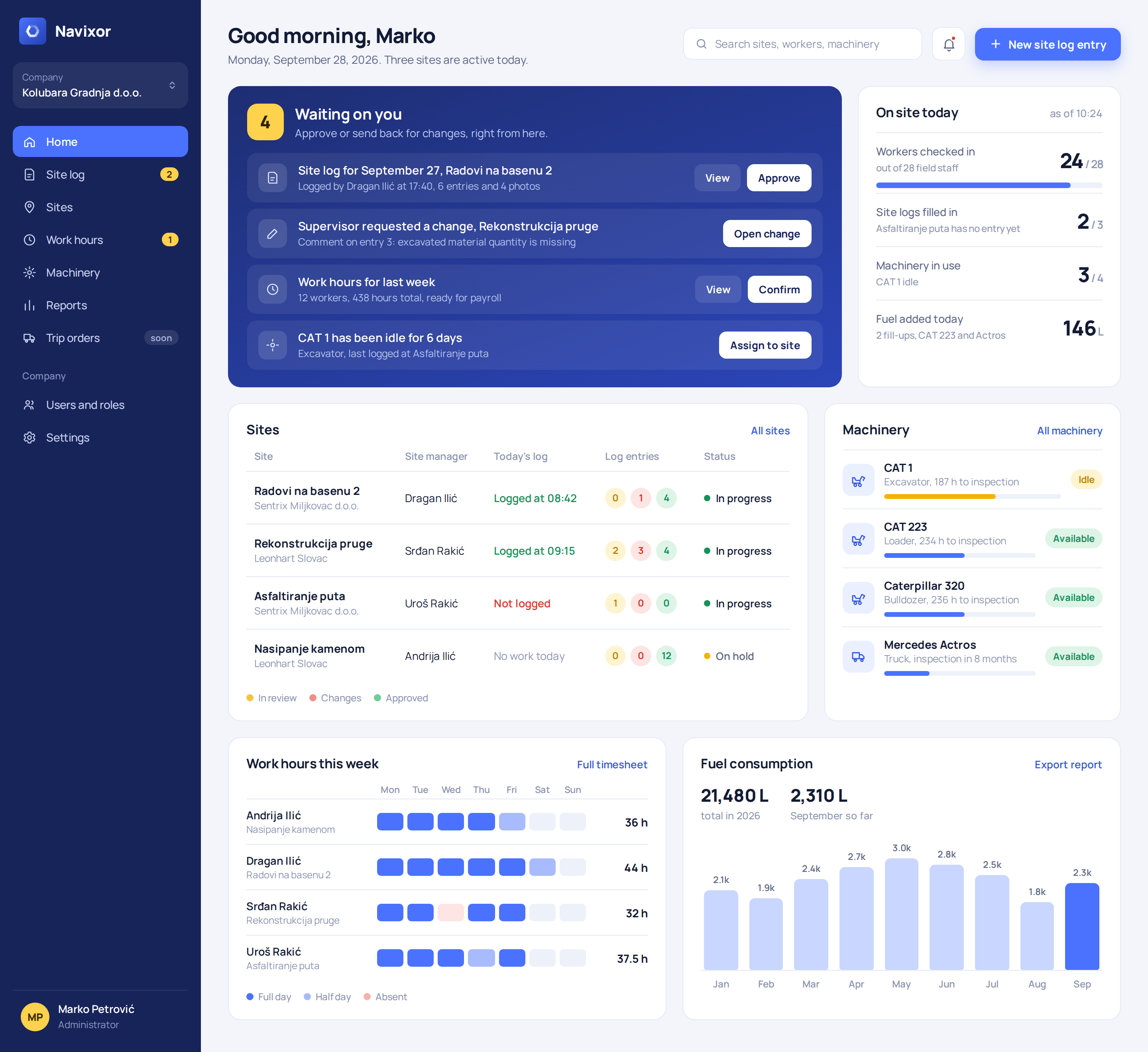
The main view is intentionally organized around what needs attention, not around charts. Management can immediately see site logs waiting for approval, requested changes, work hours ready for payroll, and machinery that has been idle for too long.
Below that, the same dashboard shows the state of active sites: workers checked in, logs completed, machinery in use, and fuel added. It replaces the morning round of calls with a shared, current picture of the operation.
A single operational view for approvals, sites, machinery, work hours, and fuel.
Designed for adoption
Faster than paper, or it will not be used.
The first version of the previous application did not fail because of technology. It failed because it did not fit the people expected to use it.
Navixor removes every field that is not legally or operationally necessary. Where the system already knows the information, it fills it in. A trip order can retain its full legal structure while leaving the driver with only a small number of fields to complete.
The system also allows field teams to record past dates. Rather than punishing a late entry, it makes it possible to capture complete information when the team has time.
- Practical phone-first entry
- Pre-filled operational information
- Past-date entry when work allows
- Quiet visual signals for missing site logs
- Role-specific views with less training and fewer errors
Access and roles
Every role sees the work it needs — and not the work it does not.
The platform was designed around the jobs of management, site managers, supervisors, and drivers. A supervisor sees only the logs that require their signature. A driver does not see payroll data. Management has the cross-company picture needed to make decisions.
This keeps the interface clear while protecting sensitive operational information and avoiding unnecessary complexity for field users.
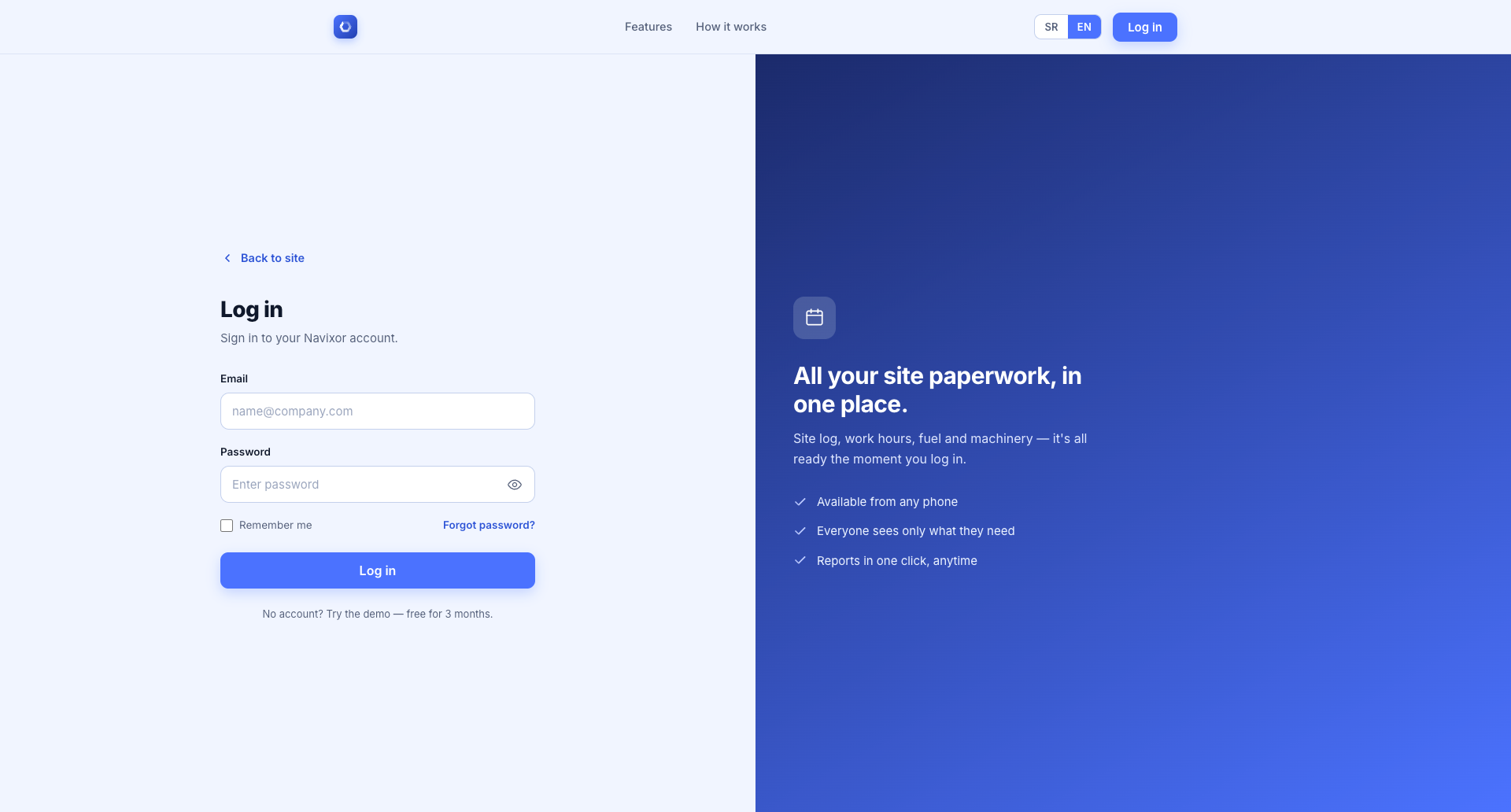
A focused access experience supports role-based workflows from any device.
Operational records
Sites, machinery, work hours, and fuel stay connected.
Each part of the system replaces a manual coordination task. Site managers and management can see who runs a site, when its log was entered, and whether it is under review, returned, or approved. Machinery status and engine hours make upcoming service needs visible before an idle machine becomes a surprise.
Weekly work-hour records support payroll preparation without manually adding notebooks. Fuel consumption can be reviewed by month and exported for reporting, removing the multi-day reconstruction that annual reporting once required.
Sites
See site managers, log status, pending reviews, and missing entries.
Machinery
Track availability, engine hours, servicing needs, and idle equipment.
Work hours
Maintain weekly records by worker and site for payroll preparation.
Fuel
Record fuel activity, review consumption, and export reports from live operational data.
What scales
The same principles become more valuable as the operation grows.
The more people, machines, and sites a company coordinates, the more expensive each delayed or missing record becomes. The same structure can extend across companies, departments, regions, subcontractors, and years of operational history.
A custom system can connect to ERP, accounting, payroll, GPS or machinery telematics, and fuel-card systems. It can automate hour calculations, recurring reports, and alerts for unusual fuel consumption or equipment downtime.
- ERP, accounting, payroll, telematics, and fuel-card integrations
- Automated calculations, reporting, and alerts
- Multi-company, regional, and subcontractor structures
- Role and location-based permissions
- Custom forms, terminology, and approval workflows
How we work
Start with the operational backbone, then grow from there.
The work began with discovery: understanding the business, the people involved, and the tools already in use. We mapped roles and data flows, then designed a clickable prototype for the critical workflows before development began.
The first implementation focused on the system backbone and can be introduced to one site or department first. From there, integrations and automation can be added in the order that brings the most value to the operation.
- Discovery and operational mapping
- User research and information architecture
- Prototype validation with real users
- A focused first release
- Phased rollout, integrations, and automation
The outcome
A shared operational picture, without the paperwork chase.
Navixor replaces fragmented operational records with one system that can be used in the field and understood in the office.
Instead of waiting for documents to travel, chasing people for updates, or reconstructing reports from past records, teams can work from current information connected to the site, machine, worker, and company it belongs to.
The result is not just digitized paperwork. It is a more reliable way to run a distributed operation.
- Faster site-log capture and approval
- Better visibility across sites and machinery
- Less manual reporting and reconciliation
- Focused role-based workflows
- A foundation for integrations and automation
What this project represents
Custom software works when it fits the work people actually do.
Navixor is not an off-the-shelf product. It is an example of how Cerato Systems approaches operational complexity: understand where the information is created, who needs it, where the chain breaks, and what should happen next.
That approach applies wherever people work across locations, depend on approvals, and spend too much time holding disconnected tools together.